

Yesterday I launched PG.center, a Chinese mirror of the PostgreSQL website. The response was immediate.
There was one obvious gap, though: at launch, the site only had Chinese docs for PostgreSQL 18. Versions 17, 16, 15, and 14 are all still within lifecycle support, but I had taken the lazy route and temporarily left those sections in English.
Today my Codex quota reset, so I burned through this week’s allowance and finished the rest. At this point, all five actively supported PostgreSQL major versions now have full Chinese documentation online:
- PostgreSQL 18 Chinese Docs (current latest major version)
- PostgreSQL 17 Chinese Docs
- PostgreSQL 16 Chinese Docs
- PostgreSQL 15 Chinese Docs
- PostgreSQL 14 Chinese Docs
Because PG 18 had already been translated carefully, the work for 17 through 14 was mostly incremental. Even so, it still took a full day and several review passes to get them into shape.
About These Docs #
The Chinese PostgreSQL community has organized volunteer translation efforts before, but timeliness was always the weak point. Sometimes a major version had been out for a year and the documentation still was not fully translated.
With AI, I think this problem is finally tractable.
I plan to maintain these docs continuously. Whenever PostgreSQL ships a minor release, I will sync the updates and keep the Chinese version current.
The hardest part was not the literal translation. It was establishing a stable terminology standard first. We normalized a lot of core terms, for example translating “token” consistently as a standardized Chinese equivalent instead of letting terminology drift from page to page. That terminology work matters. It is what keeps the docs coherent instead of turning them into a pile of individually translated pages.
The source will also be published on GitHub. If you spot anything awkward or incorrect, feel free to send corrections.
More Than Translation #
PostgreSQL’s official docs have long been one of the best technical resources in the database world. They are still the best place to learn PostgreSQL seriously.
Now PG.center provides Chinese translations for every active PostgreSQL release, which should be a clear win for Chinese-speaking users.
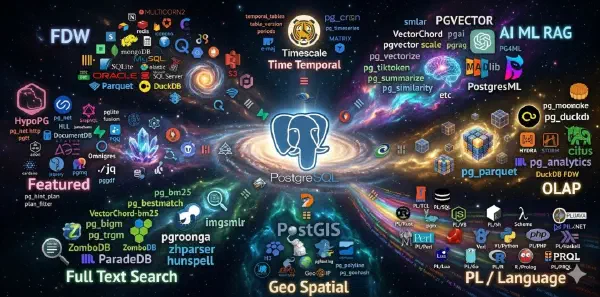
I also added a product directory to the site and listed a number of PostgreSQL kernels and PG-based tools there. If you maintain a PostgreSQL-related utility that is not listed on the official site, you are welcome to register and submit it.
That is the update: Chinese docs for all five active PostgreSQL major versions are now live, and you can read them on PG.center.
Is there any selfish motive here? Sure, a little. Having this corpus available also makes it easier for me to build useful things later, such as a PostgreSQL knowledge base. But no, I am not going to plaster the site with low-grade ads. At most I might leave a small Pigsty link in some corner. That is about it.