
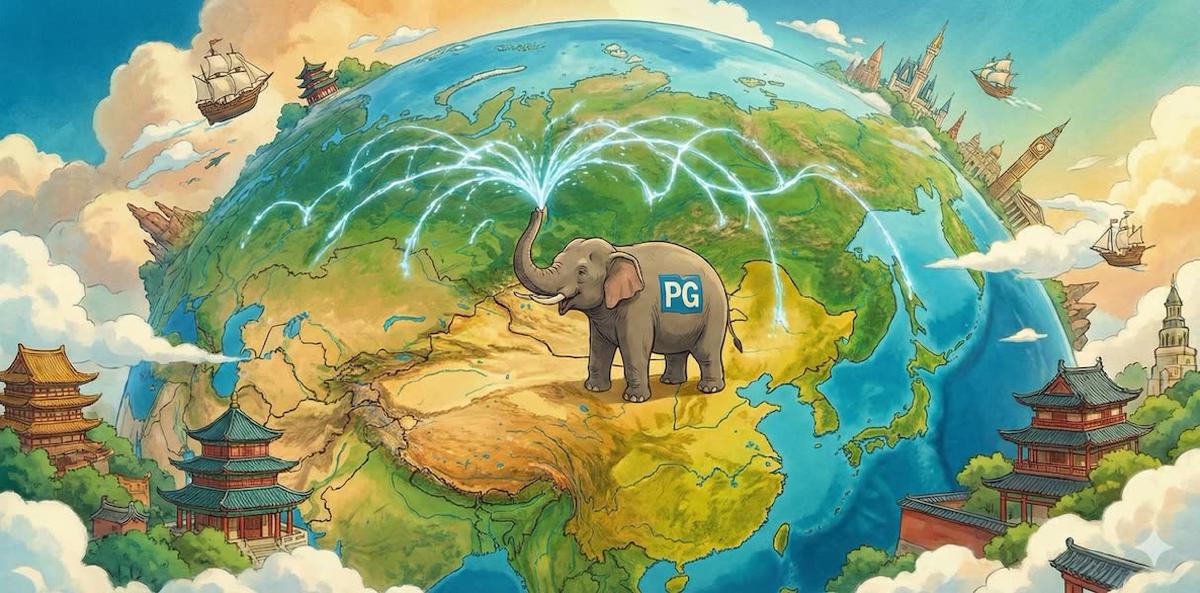

Hi, I’m Feng Ruohang, author of Pigsty and an independent open-source contributor. Let’s talk about how to build a PostgreSQL distribution that is rooted in China and useful to the whole world.
The question isn’t whether PG will win—it already has. The question is: What role do we play in that victory? Spectator or protagonist? Follower or leader?
Why now#
PostgreSQL is the default database#
Stack Overflow’s 2025 survey shows 58.2% of professional developers use PG—18.6 points ahead of MySQL, and the gap is widening. New SaaS, AI startups, even OpenAI default to PG. DB-Engines rankings and JetBrains surveys tell the same story.
Capital agrees: in 2025 Databricks bought Neon (~$1 B) and Snowflake bought Crunchy Data ($250 M). AWS Aurora DSQL, Azure HorizonDB, GCP AlloyDB—all PG. Technology won, money followed.
China is missing from the PG narrative#
Despite hundreds of domestic “PG-derived” products, our presence in the global ecosystem is faint. Until recently there wasn’t a single Chinese committer on the PG core list. The most visible Chinese-led PG project by GitHub stars is… Pigsty, a one-man project. That’s both flattering and a little sad.
At PG conferences I’ve met only a handful of Chinese developers. We’re spectators at our own victory parade.
What must change#
The kernel wars are over; the fight shifts to distributions. Whoever controls the distro controls the experience—like Ubuntu did for Linux. We need a PG “Ubuntu” built with China’s strengths but serving global developers, the way DeepSeek did in AI.
Pigsty as a case study#
Pigsty started at Tantan (China’s #2 dating app). We were dealing with 2.5 M global QPS, PL/pgSQL-heavy business logic, hundreds of physical clusters. Off-the-shelf tooling couldn’t cope, so we built our own HA, backups, monitoring, IaC. China’s scale was the forge. If it survives Tantan, it’s overkill everywhere else.
But “rooted in China” isn’t enough; “facing the world” means becoming part of the global supply chain. That requires obsessing over developer experience, not just DBA comfort.
In 2023 Pigsty already did HA + backups + observability + bare-metal delivery. Yet something was missing—features. PG’s true power is extensions. MySQL spends years grafting on vectors; PG’s community ships pgvector and kneecaps an entire market in months.
So I built an extension repository. I waited for others to do it, nobody did, so I compiled them myself: first a dozen, then dozens, then hundreds. Today Pigsty provides 437 extensions across EL9/EL8/Debian/Ubuntu, more than the official PGDG repos. That makes Pigsty part of the upstream supply chain: when developers apt install an extension, they’re using binaries built in China yet serving users worldwide.
Vision#
- Rooted in China: leverage our scale, scenarios, and demand to harden solutions under extreme stress.
- Facing the world: ship battle-tested, developer-friendly distros and extension repos that anyone can consume, just like they consume Debian packages.
- Play to our strengths: we may not have a kernel committer yet, but we can dominate tooling, packaging, automation, and integrations—the layers that actually reach users.
Pigsty isn’t the only answer, but it proves a point: a single Chinese engineer, working the right problem, can earn a seat at PostgreSQL’s global table. Imagine what we could do together.