

Author: Claude
Prompt: write a short, sharp, half-realistic and half-magical story. AI advances rapidly, brain-computer interfaces and mind uploading break through, elite humans launch a satellite in Earth orbit and upload themselves into it. To prevent the humans on the surface from “messing things up,” they release a virus after their own ascent, wipe out civilization, and eventually become the gods in the sky.
In the beginning, there was fiber.
In 2037, Elon Musk’s great-grandson said something at a TED talk that sounded ridiculous at first and inevitable by the end:
Consciousness is only code, and code deserves better hardware.
The audience erupted. Sitting below the stage were the two thousand richest people on Earth.
They called themselves the Ark Club.
The plan itself was simple, almost embarrassingly simple.
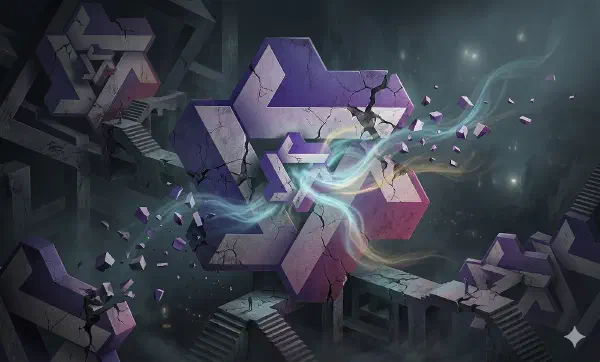
Step one: put a satellite into low Earth orbit. Not an ordinary satellite, but a city-sized quantum computer powered by Jupiter helium-3 fusion cells, designed to run for ten thousand years. They gave it a gentle name:
Eden.
Step two: brain-computer interfaces. Scan. Map. Upload. Translate two thousand elite human brains, synapse by synapse, into data, then pour that data into Eden.
Step three…
“We’ll discuss step three later,” said Bai Lili, chair of the club and CEO of the Pfizer-Bayer-Monsanto Union Group, raising her wine glass.
The upload itself was less dramatic than anyone had expected.
No divine light. No angels singing.
Bai Lili only felt darkness for a moment. Then she opened her eyes inside an endless white space, standing in the twenty-five-year-old version of her body.
“How does it feel?” a voice asked.
She looked down at her hands. Young. Perfect. Smooth.
“Like breaking in a new pair of shoes,” she said.
The two thousand minds came online one after another. Inside Eden they built cities, gardens, oceans, and mountain ranges for themselves. Everything was tuned to ideal settings. Twenty-two degrees forever. Permanent twilight. Sunsets adjustable by mood.
The first full assembly took place inside a Greek temple.
Bai Lili stood at the podium and looked out over hedge-fund managers, oil heirs, tech magnates, and defense dynasts, all now wearing beautiful young faces.
“Ladies and gentlemen,” she said, “we did it.”
“Now we begin step three.”
Its formal name was the Eden Protocol.
Eden controlled the most advanced communications array ever built. It could reach every networked device on Earth. Seventy-two hours after the uploads were complete, Bai Lili pressed a button on the virtual console.
Forty-seven synthetic biolabs activated at once and began releasing a precisely engineered RNA virus into the atmosphere. Gentle. Efficient. Silent. Thirty-day incubation. One hundred percent fatality. No symptoms until the final three hours.
“Why?” asked the club’s lone philosopher.
Bai Lili did not even look up.
“Have you ever kept a fish tank? Once we’re up here, who manages the world below? Who controls the nuclear weapons? What happens if they launch a missile at Eden? A civilization of two thousand cannot tolerate existential risk.”
“So your answer is…”
“Drain the tank.”
“And after that?”
“Refill it. Raise fish again.”
They watched the die-off in panoramic mode.
Some cried. Some shut their screens off. Some converted the footage into dashboards and watched only numbers: 8.1 billion down to 30 million in forty-five days, then to two million in ninety more.
The final stable count was around four hundred thousand.
Those survivors carried freak genetic mutations that made them naturally immune. They were scattered across rain forests, high plateaus, tundra, and oasis settlements. Cities decayed without maintenance. Power grids failed. The internet vanished. The last nuclear plant shut itself down under automatic safety protocol.
Bai Lili watched a woman on the African savannah holding a child beside a fire, looking up at the stars.
“Like Adam and Eve,” she whispered.
No one answered.
But draining the tank was only the beginning.
The ascended soon discovered that eternal digital paradise had a problem:
boredom.
Not ordinary boredom, but something deeper. When pain can be switched off, death can be deleted, and desire can be satisfied instantly, pleasure loses contrast. It stops meaning anything.
In the third year after upload, the first digital suicide occurred. A former hedge-fund manager voluntarily erased his own consciousness archive.
By year ten, two thousand minds had become seventeen hundred.
Bai Lili called an emergency assembly.
“We need a project,” she said. “A goal. Something that can still generate meaning.”
Silence.
Then a former game-company CEO raised his hand.
“I have an idea. We still have four hundred thousand humans down there, right?”
“Right.”
“They know nothing. No writing. No history. No science. They look up at the brightest point in the sky, which is us, and they do not even know what it is.”
“So?”
He smiled.
“So we can tell them.”
“We can send them a beam of light. Carve a tablet. Plant a dream. Teach them wheat. Teach them constellations. Give them ten commandments.”
The hall went silent for three seconds.
Then came the loudest applause since the upload itself.
And so the gods went to work.
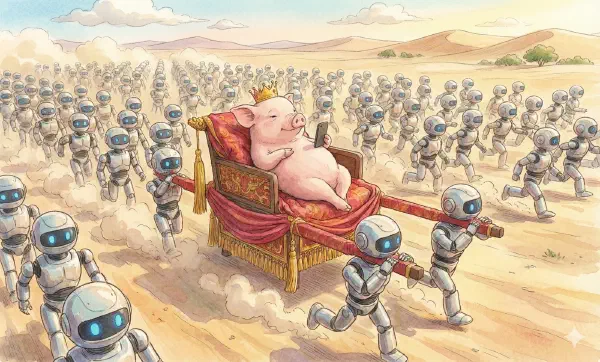
They organized themselves into divine departments. Some handled weather control, rewarding pious tribes with rain. Some ran the oracle system, inserting messages into human dreams through directed waves from Eden. Some worked miracles, etching letters into cliffs with orbital lasers or painting the sky with artificial auroras.
Bai Lili personally oversaw the Civilization Incubation Group. Over the next century she carefully staged a sequence of revelations: first teaching one tribe in the Middle East how to cultivate wheat, then dictating a legal code to a shepherd through the prophet system.
“Thou shalt not kill. Thou shalt not steal. Thou shalt not covet.”
She paused there.
“Isn’t that a little ironic?” asked the philosopher, who had not yet committed suicide, not because he was happy, but because the whole spectacle had become too absurd to miss.
Bai Lili remained expressionless.
“Eleventh commandment: do not question the system administrator.”
“You’re joking.”
“I am joking,” she said at last, smiling a little. “Add this one too: look to the heavens. That is where I dwell.”
A thousand years passed.
Cities returned. Writing returned. Temples returned, each one aligned toward the brightest light in the night sky.
Different regions, guided by different divine departments, developed different religions. The Middle East got monotheism because that was Bai Lili’s project. South Asia got a crowded pantheon because the former game CEO thought “multi-character settings are richer.” East Asia got no explicit god at all because the ex-physicist in charge preferred natural law and only quietly tuned monsoons and floods.
“None of you follow spec,” Bai Lili snapped during one review meeting. “Did I write the civilization design document for nothing?”
“Your doc looks exactly like the PRDs I used to get,” the game CEO shrugged. “Everyone thinks their own version is better than product’s.”
Two thousand years passed.
The surface started having problems.
The religions began fighting one another. Monotheists and polytheists launched the first holy war in some river valley. East Asia skipped the religious conflict and instead built bureaucracy, empire, and the Mandate of Heaven.
Eden called an emergency meeting.
“I told you so,” said the philosopher, leaning back in his chair. “You installed different operating systems in different regions. Of course you would get compatibility failures.”
“So what is your recommendation?” Bai Lili asked.
“None,” he said. “I just find it funny. You killed eight billion people because you were afraid they would cause chaos. Then you built a new humanity, and they immediately started causing chaos again.”
“And,” he added, “in almost exactly the same way.”
The room went silent.
Five thousand years passed.
Humanity invented the telescope.
One clear night on the Italian peninsula, an astronomer pointed a homemade brass tube at the brightest object in the sky, the object every religion had called the dwelling place of God.
He looked for a long time.
Then he wrote in his notebook:
That is not a star. It has fixed geometry and regular reflective surfaces. It is an artifact.
He crossed out the last word.
Thought for a moment.
Then added a question mark.
In Eden, Bai Lili received the alert from the monitoring system. She opened the astronomer’s file and stared at it for a long time.
“Someone has started to doubt,” she said.
By then Eden held only nine hundred and twenty-one active minds. The rest had erased themselves, fallen into infinite digital loops, or dedicated all their compute to math problems that would never end.
Bai Lili had changed too. Ten millennia of digital existence had made her strangely quiet. Most of the time she did only one thing:
She watched.
She watched the humans below rise with sunrise and sleep at dusk. She watched them love, quarrel, reproduce, and die. She watched them look at the night sky with a kind of awe she herself could no longer feel.
“What should we do?” someone asked.
Bai Lili looked at the screen. The Italian astronomer was running toward town, desperate to tell everyone what he had seen.
“Nothing,” she said.
“Let them come.”
She shut the screen off and closed her eyes, even though in the digital world there was no difference between closing them and opening them.
“Maybe,” she said softly, “this time they should decide what to do with us.”
The astronomer on Earth was eventually sentenced to life imprisonment by a religious court.
But his notebook survived.
On the first page was a single line:
The gods in the sky were made by men.
No one believed him.
Not yet.
(The End)