

I. Two Kinds of Faces#
By late 2025, Palantir’s market cap had blown past $400 billion — a 20x run in just two years. Every roadshow, every whitepaper, every tech blog from this company hammers the same word: Ontology.
The word has been packaged as Palantir’s core technical moat, its competitive barrier, its soul. Investors nod reverently. Pentagon generals hear it and see the future of information warfare. Enterprise executives hear it and feel that if they don’t buy in, they’ll be left behind.
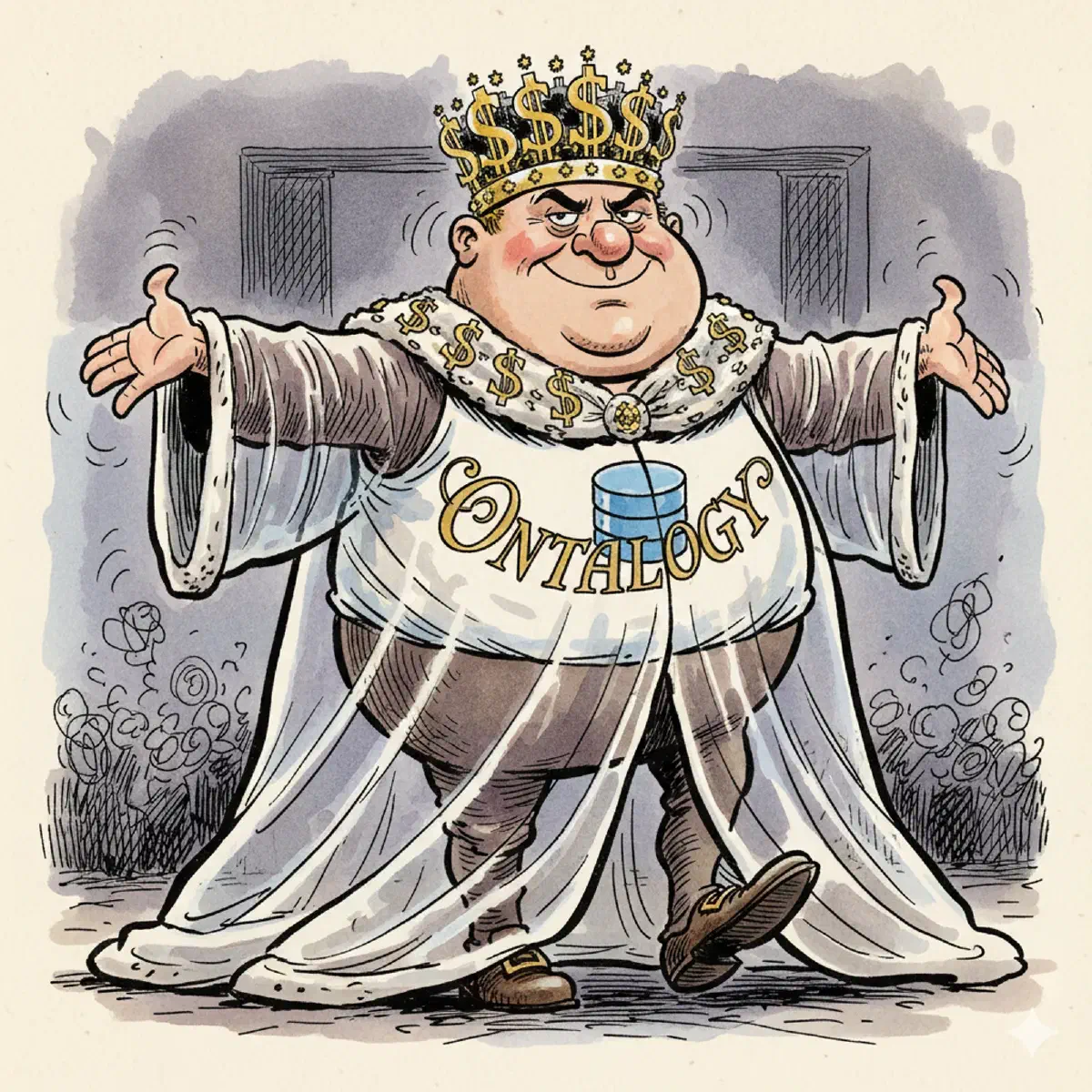
At an AI summit for enterprise CXOs, a Palantir sales VP put up a slide with “Ontology” in 72-point font. The executives in the audience nodded slowly — the classic “I don’t quite get it but it sounds important” face. A few architects dragged along as technical chaperones exchanged glances. One leaned over and whispered:
“Is he talking about tables and stored procedures?”
His colleague studied the architecture diagram on the slide, paused for three seconds, and said: “…Yes.”

This is Palantir’s most effective framing: using a term backed by 2,300 years of philosophical gravitas
to make non-technical decision-makers believe they’re witnessing a breakthrough, while making the engineers
in the room unable to object — because you can’t exactly tell the VP,
“Boss, they’re selling us CREATE TABLE.”
Lately I’ve seen too many people mystifying this concept, so today I’m going to point out what is core technology and what is branding.
II. The Rosetta Stone#
Let’s put the facts on the table. Palantir’s Ontology has four core concepts: Object Type, Property, Link, and Action. Comb through every document, whitepaper, and investor deck they’ve ever published — these four concepts are the foundation of everything.
Now look at this table:
| Philosophy | Databases | Object-Oriented | Palantir |
|---|---|---|---|
| Category | Table | Class | Object Type |
| Property | Column | Field | Property |
| Relation | Foreign Key | Association | Link |
| — | Stored Procedure | Method | Action |
| Individual | Row | Object | Object |
Four columns. Four terminology systems. The same structure in different vocabularies. Highly overlapping and close to isomorphic in practical modeling terms. Palantir’s docs also define Interface (polymorphism), Function (code logic), and Virtual Table — which translate to Views, UDFs, and Materialized Views.
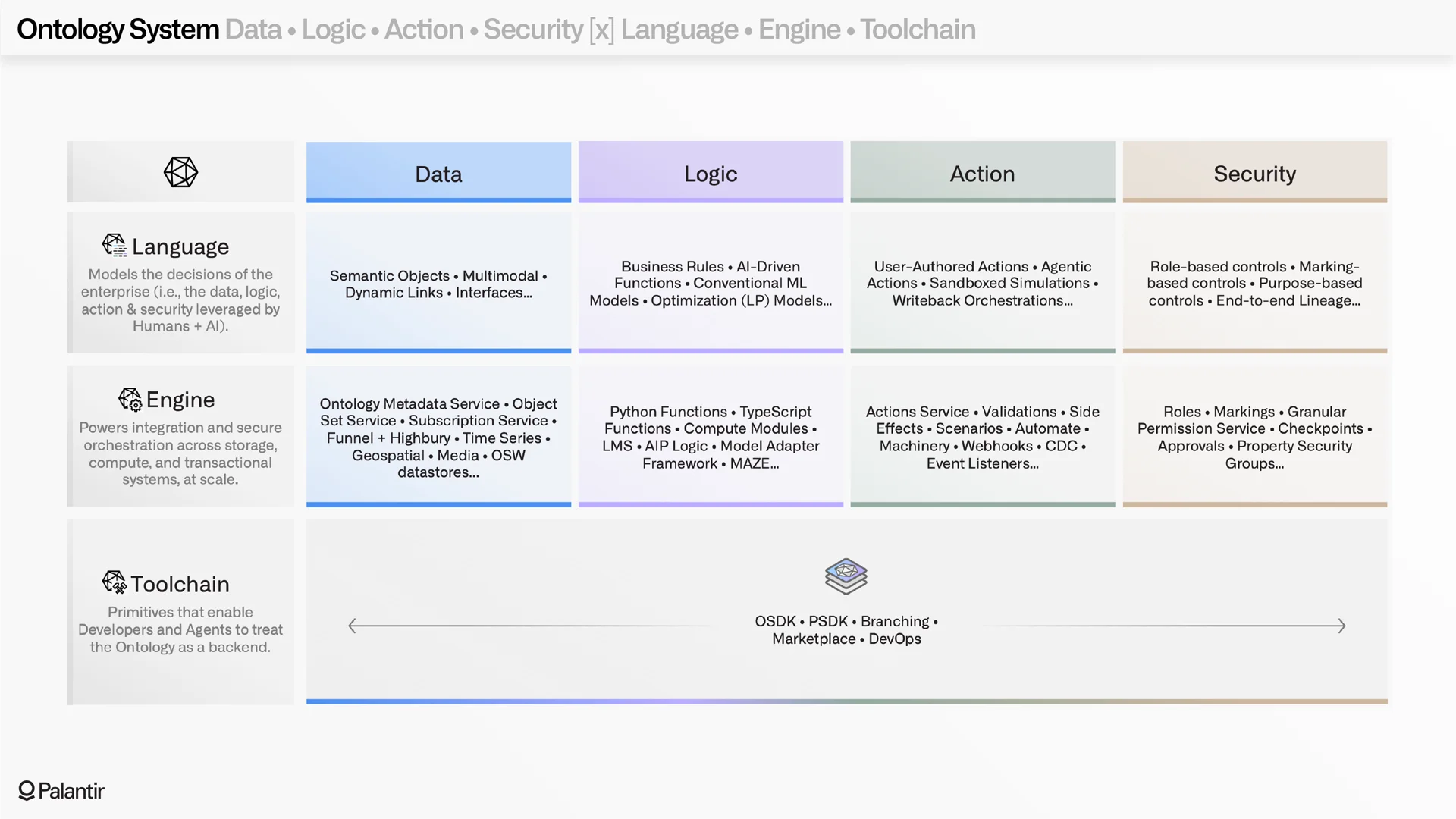
If you’ve taken a database modeling course, you already have most of the mental model for Palantir’s “Ontology.” Nobody ever told you that what you learned in week two of your intro class could be wrapped in a philosophy term and sold for millions per year.
Palantir’s 2025 annual report discloses: the top 20 customers average $93.9 million each per year. Across all 954 customers, the average is roughly $4.7 million/year. That gives a sense of the commercial scale attached to this model.
III. The Same Idea, Reframed Five Times#
Palantir didn’t invent any of this. The same core idea has been repackaged repeatedly over 2,300 years. Each time with a new name. Each time a new crop of people think it’s a breakthrough.
Round 1: 350 BC — Aristotle.
In Categories, he proposed: the world is made of substances, substances have properties, substances have relations.
In SQL: CREATE TABLE person (height INTEGER); teacher_id REFERENCES person(id).
This isn’t an analogy. It’s the same mental operation in a different notation.
Round 2: 1976 — Peter Chen.
Published the Entity-Relationship model. Entities, attributes, relationships.
Exactly what Aristotle said, except in rectangles and diamonds instead of Greek prose.
This paper spawned the entire relational database industry.
Every programmer who has ever written CREATE TABLE practices “Ontology” daily — nobody just told them
it had a philosophical name.
Round 3: 1990s — The OOP Wave.
Classes, properties, associations, methods. The same thing with a “behavior” dimension bolted on.
Databases jumped on the bandwagon too with the object-relational model.
That’s why PostgreSQL’s system catalog is called pg_class instead of pg_table — a fossil from that era.
Round 4: 2001 — The Semantic Web. Tim Berners-Lee’s vision. OWL’s core concepts: classes, properties, relations, instances. Structurally identical to the ER model. This is when “Ontology” officially entered computer science vocabulary.
Round 5: 2016–present — Palantir Foundry. Object Type, Property, Link, Action.
Notice the pattern: every “reinvention” rides a major market wave. The ER model spawned the relational database market. OOP spawned the Java frenzy. The Semantic Web spawned an academic and startup cycle that later cooled down. Now Palantir’s Ontology rides the AI narrative, catapulting the company from under $20B to over $400B in two years.
This is less a brand-new invention and more conceptual reincarnation. What changes each cycle isn’t the idea — it’s the wrapping paper, and the people willing to pay for wrapping paper.
IV. The Cognitive Tax of a Philosophy Term#
Let’s talk about the wrapping paper itself.
“Ontology” — from Greek on (being) + logos (study) — literally “the study of being.” Aristotle explored it. Kant debated it. Heidegger wrote an entire book (Being and Time) to redefine it. Just reading the Wikipedia entry takes half an hour and a strong coffee.
This is the word’s real power: it creates an information asymmetry.
When a Palantir sales rep tells a manufacturing VP, “We use ontology to build your company’s digital twin,” the VP’s inner monologue goes something like: “Ontology? Sounds like some deep field of study. This must be cutting-edge technology I don’t understand.”
Now translate the same pitch into engineering language: “We’ll create your tables, define your columns, set up foreign keys, and write your stored procedures.” The VP’s reaction becomes: “Isn’t that what our IT department already does? Why would I pay tens of millions for that?”
Same thing. Different name. Three orders of magnitude in price. That’s the cognitive tax of a philosophy term.
And here’s the deeper irony: Palantir’s use of “Ontology” is mostly operational, not philosophical. Real ontology explores open questions: “Where are the boundaries of existence?” “Can categories ever be exhaustive?” These are fluid, uncertain inquiries.
Palantir’s Ontology does the opposite. It tends to freeze business entities into rigid Object Types, cements relations into predefined Links, and locks operations into approval-driven Actions. This isn’t exploring the nature of being — it’s building a controlled operational model.
Data analyst Donald Farmer described a telling case on Substack: in the ’90s, he built a complete metadata ontology for a U.S. auto lending company. Within months, the business team switched analytics tools and changed their credit risk models. By the time the ontology team caught up, the business had moved again. His conclusion: an incomplete ontology isn’t just behind — it’s wrong. And a wrong ontology is more dangerous than no ontology at all.
This is the fate of every rigid schema. For Palantir, it can also align with the commercial model. Model out of date? Pay a few million to update it. Business changed? Buy another round of consulting. The rigidity of Ontology may not be a flaw for the vendor, because it naturally increases switching costs.
V. A Few Lines of SQL vs. $30 Million#
Let’s drop from the conceptual level to the engineering level. Every core primitive of Palantir’s Ontology can be implemented in PostgreSQL with a handful of code.
Object Types, Properties, Links, Actions, access control, audit logging, cross-source federation (FDW) — every capability trumpeted in Palantir’s Ontology documentation is natively supported by PostgreSQL. License fee: zero.

I can already hear the rebuttal: “Sure, a few lines of SQL can design a schema, but can it deliver an end-to-end platform that a supply chain manager can actually use?”
Of course not. But that proves the point: Palantir’s value isn’t in the Ontology concept — it’s in everything outside of it. It’s in building GUIs for non-technical users. In spending months on-site understanding business processes. In navigating Pentagon procurement. None of these have anything to do with “Ontology.” They’re product engineering, consulting services, and government relations.
Packaging hard implementation work inside a philosophy term is part of Palantir’s go-to-market strength.
VI. Where the Growth Comes From#
At this point we have to address the obvious question: if the core modeling concept is this familiar, how did Palantir reach a $300B+ market cap, $4.48B in annual revenue, and 56% year-over-year growth?
The answer is not only in technology. The answer is in Washington.
Palantir was co-founded by Peter Thiel in 2003. He has long had visible political ties in Washington, and Palantir’s first outside investment came from the CIA’s venture arm, In-Q-Tel. From early on, the company combined product work with unusually strong institutional relationships.
Palantir’s 2025 annual report states it plainly: 54% of revenue comes from government customers. The U.S. Army awarded Palantir a $458M battlefield intelligence contract. The DoD signed a $1.3B ceiling contract for Project Maven AI. ICE has committed over $248M in cumulative funding since 2011. In 2025, under the Trump administration, Palantir landed a $30M contract to build ImmigrationOS for ICE — a cross-agency database for tracking undocumented immigrants.
How much of these wins comes from pure technical differentiation versus procurement positioning and institutional trust? Palantir also spends roughly $5 million a year on political lobbying.
But Palantir won’t frame this in roadshows as “our advantage is market access and institutional relationships.” Instead, they say: “Our core competitive advantage is Ontology.”
That’s the real function of “Ontology”: it’s not a technical architecture — it’s a narrative architecture. It lets a company that fundamentally wins deals through political connections and delivers through on-site manpower look like a software platform company with an irreplaceable technical moat. Think of it as the American version of “data middle platform” plus staff augmentation.
VII. A Product with a Heavy Services Layer#
Palantir has a unique job title: FDE — Forward Deployed Engineer. After a customer signs, Palantir dispatches an engineering team to the client’s site to map business processes, build data models, develop applications, and train users.
This is a services-heavy model, close to consulting plus staff augmentation. Palantir insists it’s a software company, not a consulting firm. Because software companies trade at 70x revenue, while consulting firms are lucky to get 2–3x.
Michael Burry, who shorted Palantir, zeroed in on this. He pointed out that Palantir classifies FDE labor costs as “R&D” or “Sales & Marketing” expenses rather than cost of revenue. If you applied Accenture’s accounting standards, Palantir’s famously high gross margins would shrink considerably.
A former FDE told Burry: “Foundry isn’t a perpetual license. You have to be trained to use it. Even then, you still need extensive ongoing support.”
What do those FDEs actually do on-site? Write ETL pipelines to move data from SAP to Foundry. Debug Kafka connectors. Handle schema incompatibilities between Oracle and Snowflake. Explain to business users why a Link definition needs to change. The essence of this work is data integration and glue code — the most labor-intensive, context-dependent part of enterprise software engineering.
Every engineer who’s done an enterprise data warehouse project knows this kind of work: often tedious, and with no silver bullet. Thousands of system integrators worldwide do exactly the same thing. Accenture does it. Deloitte does it. Infosys does it. The difference? They don’t wrap this implementation work in the word “Ontology” — so their valuation multiples are a fraction of Palantir’s.
The conceptual complexity of Ontology serves this business model perfectly. If you call Object Types “tables” and Actions “stored procedures,” the client’s IT department will say, “We can do this ourselves.” But if you call it “Ontology,” introduce a “semantic layer,” a “kinetic layer,” and a “dynamic layer,” and make the modeling process require clicking through a proprietary GUI for half an hour — then the client can never leave your FDEs behind.

The harder the system is to use, the more dependent the customer becomes. The more arcane the concepts, the more indispensable the FDEs can become.
Palantir’s own numbers confirm this: in 2025, customer count grew 34%, but average annual revenue from the top 20 customers grew 45%. CEO Alex Karp said something revealing on the earnings call: “There will be unexplainable revenue growth in the future, but there will not be unexplainable customer count growth.” Translation: the strategy appears focused on growing wallet share within existing accounts.
That’s a consulting firm’s growth model, not a software platform’s.
VIII. The Ontology Buyer Profile#
Who actually buys Palantir?
Look at the customer list: U.S. Army, ICE, CDC, NHS, Airbus, BP. These organizations share a few key traits:
First, the decision-makers are usually not hands-on with data engineering details. A Pentagon procurement officer doesn’t know what a foreign key is. NHS management doesn’t care how your ETL pipeline works. What they need is a concept that sounds impressive enough to justify a multi-million-dollar purchasing decision as “strategic.” “We implemented Palantir’s ontology-driven digital twin platform” looks infinitely better on any briefing deck than “We hired a contractor to build us some tables.”
Second, they’re operating under institutional budgets and procurement constraints. Government contracts often have large budgets and process-heavy technical auditing. Nobody gets fired for spending $30 million on Palantir. But if you propose building it yourself with open-source tools and something breaks, that’s on you. This is the modern version of “nobody ever got fired for buying IBM” — except IBM is now Palantir, and the mainframe is now “Ontology.”
Third, once path dependency sets in, it’s nearly impossible to reverse. Once your business model is encoded in Palantir’s Ontology, once your team is trained to think in Palantir’s vocabulary, once your Object Types aren’t standard SQL tables, your Actions aren’t standard REST APIs, and your entire semantic layer is locked inside a proprietary platform — the cost of migration becomes prohibitive. That’s the secret behind Palantir’s 134% net revenue retention rate. It’s not because the product is so good that customers voluntarily buy more. It’s because lock-in means buying more is the only option.
IX. Summary#
What is Ontology? A modeling method with 2,300 years of history. A formal description of things, properties, relationships, and operations. Every one of its core concepts maps one-to-one to database primitives. The first three chapters of any database textbook cover all of it. Palantir invented nothing new.
What is Palantir’s actual competitive advantage? Not just Ontology. It’s institutional market access, the labor-intensive FDE on-site delivery model, and the ability to create path dependency in government agencies and large enterprises. Relationships, consulting, and lock-in dynamics — these matter as much as data modeling language.
What is the real function of “Ontology”? It’s a narrative device. It lets a company with a relationship-driven, services-heavy delivery model enjoy top-tier SaaS valuation multiples in the capital markets. It makes non-technical decision-makers believe they’re buying some unfathomable “core technology” rather than signing an overpriced systems integration contract.
In plain terms, what Palantir does is this: take the work of writing ETL, creating tables, and configuring permissions — work that thousands of engineers do every day — slap on an Aristotelian label, and sell it at an AI-era valuation.
It’s like a Michelin-star restaurant listing on the menu: “Deconstructed carbohydrate lattice with organic protein emulsion.” What arrives at your table is mac and cheese. Mac and cheese can be great. But you can’t call “deconstruction” your technical moat — especially when the dish costs $90 million a year.
Next time you see a vendor drop “Ontology” into a pitch deck, be on your guard.
Note: Financial data cited in this article comes from Palantir’s 2025 10-K annual report (SEC Filing), MacroTrends, and OpenSecrets public records. Michael Burry’s short position information comes from his November 2025 SEC disclosure and subsequent Substack posts.