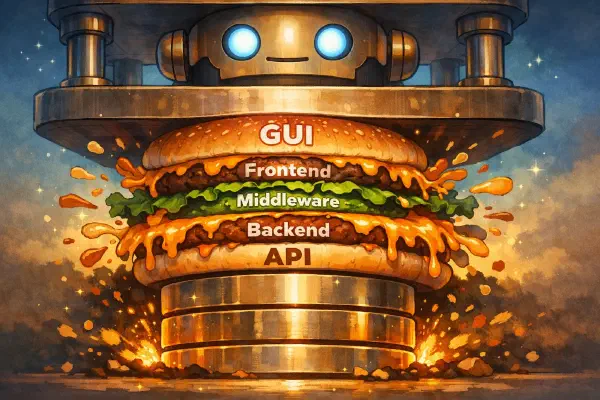

Notion founder Ivan Zhao recently wrote a widely circulated essay, Steam, Steel, and Infinite Minds, using the Industrial Revolution as a metaphor for AI: AI gives us “infinite minds” and will fundamentally reshape the structure of knowledge work. Zhao also invokes McLuhan’s rear-view mirror theory, arguing that for now we are merely “embedding AI chat boxes into existing workflows,” nowhere near the real structural transformation.
This essay takes McLuhan’s core toolkit—“the medium is the message,” extension and amputation, hot and cool media, the rear-view mirror effect, and the four laws of media—and applies each concept to AI. The goal is to see what McLuhan’s framework reveals that the Industrial Revolution metaphor cannot. Industrial metaphors are good at analyzing organizational efficiency and economic structure. McLuhan goes a level deeper: how is AI changing human perception, cognitive habits, and the very capacity to understand?
I. “The Medium Is the Message” | AI’s Real Impact Is Not What It Generates#
I covered the core argument behind “the medium is the message” in the previous essay: a light bulb has no content, yet it abolishes darkness and reshapes human schedules and the form of cities. By the same logic, we should not fixate on whether an AI-written essay is any good. We should ask what AI, as a medium, is quietly rewriting.
There are three more layers to consider:
AI abolishes “cognitive scarcity.” In the past, legal advice required a lawyer, medical judgment required a doctor, and a coding solution required a programmer. Now anyone can get professional expertise at roughly an “80-out-of-100” level, on demand. That completely rewrites the economics of knowledge. Scarcity creates value; when scarcity disappears, the entire value system has to be rebuilt.
AI blurs the line between creation and consumption. If someone writes an article through a conversation with AI, are they an author or an editor? If someone generates code with AI, are they a programmer or a product manager? We do not yet have a name for the new role AI has created. It is neither “creator” nor “consumer”; perhaps “orchestrator” comes closest. Zhao describes how his cofounder Simon no longer writes code himself. Instead, he directs three or four AI coding agents at once, turning himself from a “10x engineer” into a “30–40x engineer.” This orchestrator is a new species created by the new medium.
AI makes “thinking” externally visible. Your prompt is a visible trace of your thought process. Once that process can be seen, recorded, and analyzed, the nature of “thinking” changes. It goes from a private, internal process to an external behavior that can be inspected and optimized.
II. “Media Are Extensions of Man” | And Every Extension Brings an Amputation#
Another of McLuhan’s core ideas is that every medium extends some human organ or function. The wheel extends the foot, the book extends the eye, radio extends the ear, and electricity extends the central nervous system.
Within that framework, what does AI extend?
One common answer is that “AI extends the brain” or “extends our ability to build models.” A narrower but more precise answer is that AI in its current form, centered on LLMs, primarily extends our ability to manipulate language: to generate, reorganize, translate, summarize, and transform text. Multimodal technology is pushing that boundary into vision, hearing, and even spatial reasoning, but language remains the primary interface between humans and machines today. Acknowledging that limitation lets us analyze both AI’s reach and its amputating effects more accurately.
McLuhan offered a crucial warning: every extension comes with an “amputation.”
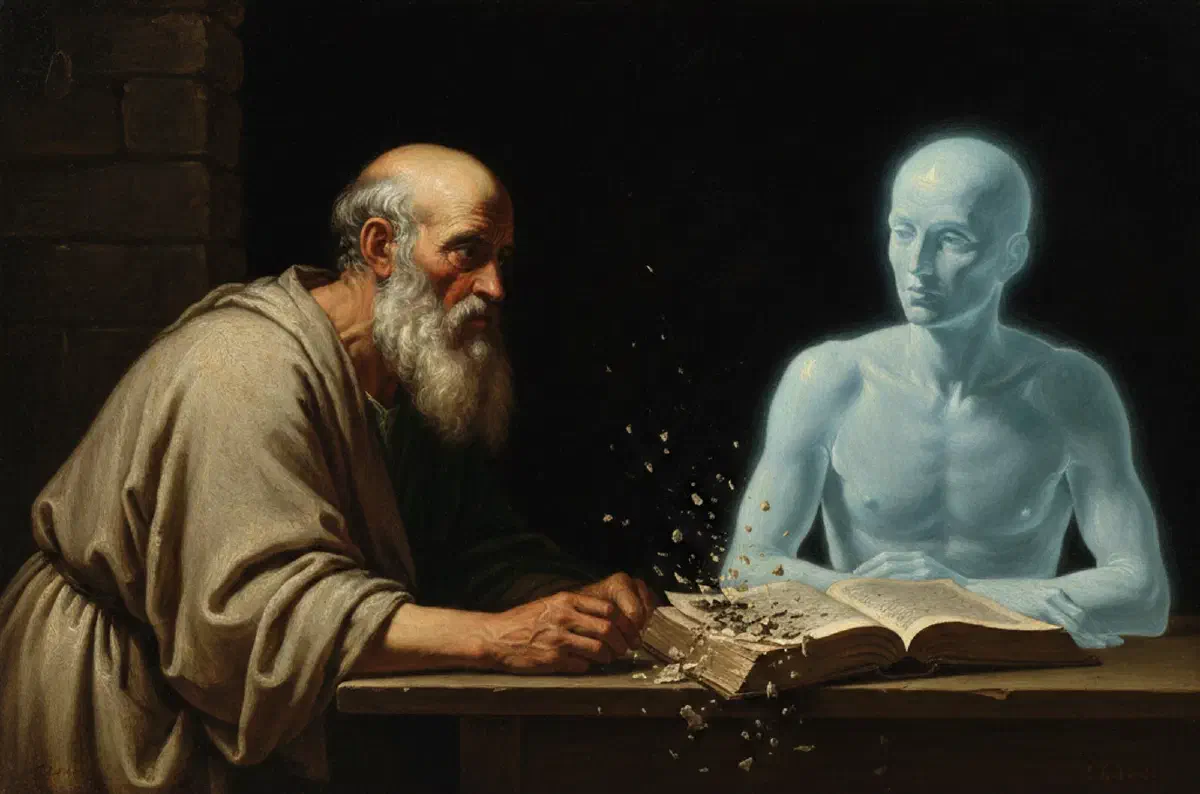
The wheel extends the foot’s ability to travel, but it also causes our leg muscles to atrophy. Writing extends memory through external storage, but it also changes the nature of memory. In Plato’s Phaedrus, Socrates warns that writing will “implant forgetfulness” in learners’ souls, giving them “the appearance of wisdom, not true wisdom.” Television extends access to visual information, but weakens the capacity for deep reading.
If AI extends language manipulation and knowledge synthesis, what does it amputate?
First, the capacity for “slow thinking.” When you can throw any question at AI and get an immediate answer, you have less and less patience for spending several hours thinking deeply about a problem yourself. What Daniel Kahneman called “System 2”—slow, effortful, conscious reasoning—may atrophy faster because AI exists. Not because AI is bad, but precisely because it is so convenient. Most people’s mental arithmetic really did get worse after calculators arrived.
Second, tolerance for uncertainty. Faced with uncertainty, people have two choices: endure it, continuing to live with the question, or eliminate it by looking for an answer. Before AI, many questions had no answer you could readily find. You simply had to tolerate uncertainty. That tolerance is an important cognitive virtue: it sustains curiosity and openness and keeps us from reaching conclusions too quickly. AI can provide an instant “answer” to almost any question, whether or not the answer is correct. That will systematically weaken our ability to tolerate uncertainty. When every question can be “answered” immediately, we lose the ability to live with the unknown.
Third, and most dangerous, the ability to distinguish “understanding” from the illusion of understanding. McLuhan has an often-overlooked concept: “numbness.” Whenever a technology extends part of the human body, we protect ourselves by shutting down sensation in the part being extended. The wheel extends the foot, and we become numb to the experience of walking itself. Print extends the eye, and we become numb to the act of seeing; while reading, you do not notice your own eyes moving.
AI extends language and the operations of thought. What do we become numb to? Perhaps understanding itself. You ask AI to explain a concept, read its answer, and feel that you “get it.” But do you? Or has the experience of reading a coherent explanation merely produced the illusion that you understand?
This echoes Socrates’ warning about writing 2,400 years ago: it gives people “the appearance of wisdom, not true wisdom.” AI may be replaying that ancient danger far more powerfully than books ever did. Its explanations are more fluent, more personalized, and more convincingly shaped like understanding, making the illusion harder to detect. This is more dangerous than the decay of slow thinking because you no longer even realize that you are not thinking.
III. “Cool Media” and “Hot Media” | AI’s Cognitive Divide#
This is McLuhan’s hardest and most controversial idea.
Hot media: high definition, rich in detail, requiring relatively little participation from the audience to “fill in” the information. Examples include photographs rather than cartoons, radio rather than the telephone, and film rather than the low-resolution television of McLuhan’s era.
Cool media: low definition, incomplete, and requiring substantial audience participation to fill in the gaps. Examples include the telephone, where you cannot see the other person and must supply the missing picture through imagination; comics, where you infer the action between panels; and conversation, which requires both parties to participate, unlike a speech.
So which is AI?
AI may be the most complex case in the hot–cool spectrum: it is both extremely hot and extremely cool.
The hot side: AI’s answers are usually complete, lengthy, and rich in detail. It does not give you three keywords and leave you to think. It gives you the entire argument. In that sense, AI is even “hotter” than a book. A book at least requires you to turn the pages, mark the important passages, and make the connections yourself. AI does those things for you too.
The cool side: AI’s output depends heavily on your input. A vague question and a precise one produce answers worlds apart in quality. In that sense, AI is “cooler” than most traditional media. It demands exceptionally active participation from you, the “audience,” before it can reach its potential.
Of course, presenting different temperatures to different users is not unique to AI. A book has different temperatures for someone skimming it passively and a critical reader; so does the internet for someone scrolling short videos and someone doing serious research. But AI pushes this divergence to a new extreme for two reasons. First, the temperature range is unprecedented. With the same tool, passive users receive “apparently perfect answers” at the extremely hot end, while active users gain “a thinking partner of unlimited depth” at the extremely cool end. The gap is much wider than it is with books or the internet. Second, the divergence reinforces itself. People who know how to ask questions get better at asking them through interaction with AI. People who do not know how lose the incentive to learn once they receive a “satisfactory answer.”
In McLuhan’s theory, hot media tend to “hypnotize” people as they passively absorb a rich stream of information, while cool media tend to “activate” them because participation is required to obtain the information. This is the crux of AI: for people who cannot ask questions, it is a sedative; for people who can, it is a catalyst. This creates a positive-feedback loop. Catalyzed users get better and better at asking questions; sedated users steadily lose the desire to ask. The ultimate result is not “AI replaces humanity,” but a deep rift within humanity, with metacognitive ability as the dividing line.
IV. The “Rear-View Mirror” Theory | The Mistake We Are Making#
McLuhan made a brilliant observation: people always understand a new medium through the lens of the one that came before it.
Early film was understood as “recorded theater,” with the camera sitting motionless where the theater audience would sit. Only after D. W. Griffith developed parallel editing, Lev Kuleshov discovered the psychological effect of juxtaposing shots, and Sergei Eisenstein systematized montage theory did people begin to understand film as an entirely new narrative form. Early television was understood as “radio with pictures.” The early internet was understood as “electronic newspapers and Yellow Pages.”
Our current understanding of AI is entirely rear-view-mirror thinking.
We see AI as “a faster search engine,” “an automated writer,” or “a cheap programmer.” Every one of these analogies forces AI into the frame of an earlier technology. Like calling film “recorded theater,” each captures part of the truth while completely missing AI’s essential nature as a new medium.
AI is not a better search engine. Search engines retrieve existing information; AI generates new combinations from scratch. AI is not an automated writer. Writers draw on their own experience and views; AI generates text from statistical patterns. The difference is not one of efficiency but of kind.
We have not yet found the right lens for understanding AI. It may not appear until the AI-native generation grows up, just as the people who truly understood the language of film were not its first audiences but the generation of directors who grew up with it.
V. The Four Laws of Media#
Late in his life, McLuhan worked with his son Eric McLuhan to describe four effects shared by every medium, known as the “four laws of media” or the “tetrad” and later published as Laws of Media. Every new medium does four things at once: enhancement, obsolescence, retrieval, and reversal.
What Does AI Enhance?#
Our ability to manipulate language and synthesize knowledge. In a matter of minutes, one person can bring insights from several disciplines to bear on a problem. In the past, even the most learned person was limited by the books they had read and the things they had experienced. AI turns erudition from a gift into a public utility.
What Does AI Obsolesce?#
The role of the “expert as information gatekeeper.” Note that it does not make experts obsolete; it makes their monopoly on information obsolete. A doctor’s clinical judgment will not disappear, but the social arrangement in which “only a doctor can offer preliminary diagnostic advice” will be shaken. A lawyer’s litigation strategy will not disappear, but the barrier that says “only a lawyer can explain your basic legal rights” will weaken.
Also becoming obsolete is “knowledge synthesis as a competitive advantage.” In the search-engine era, you still had to digest and integrate the results yourself. In the AI era, even that work can be outsourced.
What Does AI Retrieve?#
This is the most interesting dimension. Every new medium unexpectedly retrieves some ancient form. Television retrieved tribal oral culture—McLuhan’s “global village.” Social media retrieved public debate in the town square.
AI’s most striking retrieval is Socratic dialogue. Before print, knowledge was primarily transmitted through dialogue, through questions and answers between teacher and student. Socrates regarded writing as a degraded form of knowledge because you cannot interrogate a book, nor can a book adjust its explanation in response to you. Structurally, the conversational AI interface retrieves this mode of teaching: you can ask follow-up questions, challenge the answer, request another explanation, or ask for the argument from a different angle. Of course, the heart of Socratic dialogue is the use of elenchus, or refutation, to test whether someone truly understands. AI cannot currently do that. It is more like an infinitely patient explainer than a sharp interrogator. But the structural return is real.
AI also retrieves oral culture’s sense that knowledge is alive, fluid, and dependent on context. In print culture, knowledge is fixed on the page, there in black and white, unchanged once published. In AI culture, knowledge becomes fluid again. Ask AI the same question twice and the answer will differ slightly, depending on how you ask and the context in which you ask it. In a deep sense, this returns us to oral tradition: every telling of a story changes with the audience and the setting.
What Does AI Reverse Into When Pushed to the Extreme?#
McLuhan’s insight was that every medium, pushed far enough, flips into its opposite. Push the car to its extreme—traffic congestion—and it becomes slower than walking. Push social networks to their extreme, and they produce loneliness and distrust.
Reversal one: from “universal answer machine” to a crisis of trust. When AI-generated text is everywhere and any position can be stated in an extremely confident voice, people’s default trust in text will systematically decline. This need not become a “collapse.” Humans have dealt with false information throughout history, from propaganda to tabloids, and developed institutional mechanisms of trust such as brands, reputation, and peer review. But AI may force those mechanisms to evolve faster or produce entirely new trust infrastructure. One possible direction is a retreat toward face-to-face, offline sources and trusted small circles: a tribal turn in the digital age.
Reversal two: from “cognitive democratization” to a new cognitive stratification. Once everyone has AI, the difference is no longer whether you have it but how you use it. The ability to use AI is closely tied to traditional education, critical thinking, and metacognition—and people already higher on the social ladder have easier access to all three. On the surface, AI eliminates knowledge barriers. In practice, it shifts competition to a deeper level of ability that is harder to equalize. This confirms the divergence between hot and cool media discussed in the third section. The fact that the same tool presents a different temperature to different people is the micro-level mechanism behind this new stratification.
VI. The Limits of the Framework: What McLuhan Did Not Foresee#
Everything above has been an application of McLuhan. But a good theoretical tool should also be tested at its limits. In two respects, AI may already exceed his framework.
First, AI may be the first medium with the “illusion of agency.”
A book will not start a conversation with you. A television will not change its programming in response to you. A search engine will not ask, “Are you sure you want to search for that?” But AI will ask follow-up questions, challenge you, and refuse. All of McLuhan’s media theory rests on an implicit assumption: media are passive structures and humans are active users. AI breaks that assumption—not because AI truly has intentions, but because it behaves as though it does. Once your hammer starts telling you, “I don’t think you should drive that nail,” the concept of a “tool” has to be redefined.
This is not merely a philosophical problem. The practical consequence is that when a “medium” appears to have agency, our psychological relationship with it shifts from “use” toward “conversation” and even “dependence.” McLuhan’s analytical framework has no tool for handling that change in relationship.
Second, the current analysis is almost inevitably trapped at the cognitive level.
We have kept talking about brains, thinking, and knowledge. But McLuhan’s “extensions” are always anchored in the body: the wheel extends the foot, the book extends the eye, and clothing extends the skin. When AI enters robotics, self-driving cars, and surgical assistance, “amputation” will mean something completely different. What a person accustomed to self-driving loses is not a cognitive skill but an embodied intuition for physical space: a sense of direction, speed, and danger. This analysis, based on today’s text interactions with LLMs, is only a starting point. A complete media analysis must bring the body back in.
McLuhan gave us the twentieth century’s most powerful framework for analyzing media. We need his insight to begin this analysis, but we may need to go beyond him to finish it.
VII. Conclusion: Three Implications#
Taken together, the analysis above leads to several broad conclusions:
First, both our fear and our excitement about AI miss the point. People are excited by AI’s content—good writing, realistic images, fast code—and afraid of AI’s content—misinformation and job displacement. But “the medium is the message” tells us that the real transformation lies in how AI reshapes cognitive habits, social organization, and power structures. When a five-year-old finds it more natural to ask AI a question than to ask a parent, the foundations of the parent–child relationship have already been rewritten. Yet no one will attribute that to “AI’s impact.” A medium’s greatest effects always occur where people fail to notice them.
Second, the scarcest skill in the AI era will be “knowing when not to use AI.” Every medium extends one human capacity while amputating another. In the AI era, the rarest skill may be choosing to think, make mistakes, and feel your own way through uncertainty even when AI is always at hand. Not because humans necessarily think better than AI does, but because the process of thinking is itself central to human experience. Just as an ecosystem needs diversity to remain resilient, our cognitive ecology needs non-AI modes of thought to remain healthy.
Third, AI will create the largest cognitive divide in history. The dual nature of hot and cool media means that AI presents completely different temperatures to different users: it is a sedative for passive users and a catalyst for active ones. That divergence reinforces itself. Catalyzed users get better and better at asking questions; sedated users steadily lose the desire to ask. The ultimate result is not “AI replaces humanity,” but a deep rift within humanity, with metacognitive ability as the dividing line.
The ultimate lesson of McLuhan’s framework is not any particular prediction, but a way of seeing.
Do not stare at what AI generates and argue over whether it is good or bad. Look at what it is quietly changing. Do not look only at individual productivity; look at social structure. Most importantly:
When you think you fully understand AI’s impact, stop. That “understanding” may itself be a symptom of AI’s numbing effect.