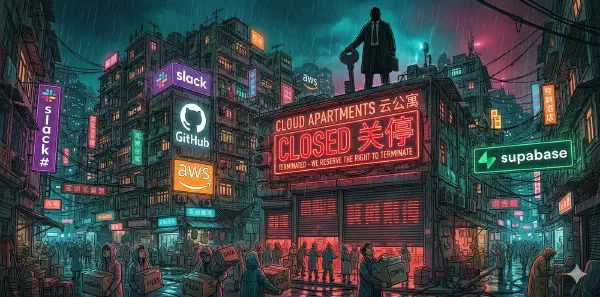


A specter is haunting the digital world—the specter of feudalism.
A thousand years ago, a farmer was born on his lord’s estate, tilled his lord’s land, paid his lord’s rents and taxes, and lived his entire life in his lord’s shadow. He was never bound in chains. He was never driven by the lash. He simply had no choice. The land beneath his feet belonged to someone else, and land was everything.
We are rebuilding that world.
I#
The defining resource of our age is not oil. It is not chips. It is not even compute. It is data. Data is the soil in which artificial intelligence grows, the fuel driving models that will reshape every industry, every profession, and every human endeavor. Who controls data controls the future.
Today, a handful of companies control nearly all the infrastructure on which data lives. They own the servers. They define the interfaces. They set the prices. The terms of service are too long for anyone to read, and everyone clicks Agree. They build walls—not to keep invaders out, but to keep you from leaving.
You store your data on their land, run your business on their platforms, and pay rent every month. The rent only goes up. Your data—your customer records, your business logic, your intellectual property, the most intimate traces of your users’ behavior—feeds their models, sharpens their algorithms, and fortifies their moats. The value you create flows upward. Your dependence sinks deeper.
This is not a partnership. It is digital feudalism.
II#
Feudalism is not just a metaphor here. The structure is the same.
In the Middle Ages, the lord provided land and protection; the serf provided labor. On its face, this looked like a fair exchange. But it concealed a fatal asymmetry, one so profound that it defined an entire era of human civilization: the serf’s labor made the lord’s land more fertile, the lord more powerful, and the serf less free. Every harvest tightened the noose.
In the digital world, cloud providers supply infrastructure and services; users supply data and money. This, too, looks fair. But it conceals the same fatal asymmetry: every byte of data you store, every business process you build, and every user action you collect makes their ecosystem more valuable, their AI more capable, and their lock-in harder to break—while making it harder for you to leave. Every month of use tightens the noose.
The medieval serf could not leave because there was not an inch of land anywhere that belonged to him. The digital serf cannot leave because migration costs have been deliberately inflated, data formats are proprietary, integrations are tangled, and the ability to operate infrastructure independently has quietly atrophied through years of outsourcing.
Feudal lords never needed violence to maintain their rule. They needed only the structure.
The structure itself is violence.
III#
We are told this is progress. We are told that cloud computing has freed us from the burden of managing servers, maintaining databases, and operating infrastructure. There is truth in that. The cloud did put powerful technology within reach—with nothing more than a credit card. It gave everyone capabilities that once required an entire IT department.
But liberation that ends in dependence is not liberation. It is a more comfortable prison.
The tobacco industry never forced anyone to smoke. It simply made smoking accessible, pleasurable, and fashionable—and then addictive. By the time the cost became clear, quitting had become one of the hardest things in the world.
Cloud computing follows the same path. Free tiers. Frictionless onboarding. Generous signup credits. Once your data is in, your architecture is entangled, and your team has forgotten how to run things for itself, prices begin to rise. Terms quietly change. The walls grow higher. At last you discover that the freedom to enter was never matched by the freedom to leave.
IV#
The damage goes deeper.
In the age of artificial intelligence, your data is not merely stored on their servers. It is digested, absorbed, and refined into a capability—then sold back to you at a markup, while being sold to your competitors at the same price.
You are not the customer. You are the mine.
The models about to reshape your industry were trained in part on your data. The AI assistants your competitors use to undercut your prices were sharpened on patterns extracted from businesses like yours. The platforms charging you ever-higher fees proclaim that they are “AI-powered”—when those capabilities were built on value you contributed for free.
This is the final humiliation of digital feudalism: you pay rent to farm land you do not own. Then the lord takes your harvest, mills it into flour, bakes it into bread, and puts it on a shelf to sell back to you.
V#
If this trajectory continues unchecked, the consequences will reach far beyond the fortunes of any single company.
A society in which the underlying infrastructure of economic life is monopolized by a handful of oligarchs will inevitably be a society of concentrated power, frozen social mobility, and innovation by permission. History has a name for such a society. It is not a flattering one.
The promise of the digital age was that technology would be the great equalizer—that one talented person with a computer could challenge an incumbent with a billion dollars. That promise is being betrayed. When the computer must connect to a giant’s cloud, run on a giant’s platform, and feed data into a giant’s models, the playing field is no longer level. The scales are tilted, and they tilt further every day.
We reject that future.
VI#
We propose another path. We call it Data Autonomy.
Data Autonomy is not a technology or a product. It is a principle and a practice.
The principle is simple: Data should be controlled by the people who generate it. Not as a slogan or a clause in a privacy policy, but as an operational, verifiable reality. Your data should be stored on infrastructure you control. Your data should go with you when you decide to move. Your data should serve your interests, not someone else’s business model.
The practice is equally concrete: We build, maintain, and freely share the open-source tools that make this principle real. Autonomy without tools is only a wish. Our work is to forge that wish into capability.
VII#
We hold the following rights to be fundamental and inalienable:
The right to know. You have the right to know where your data is stored, who accesses it, and how it is used. Not through a two-hundred-page privacy agreement written by lawyers to protect a corporation, but through clear, real-time, verifiable transparency.
The right to control. You have the right to decide how your data is stored, processed, shared, and deleted. You may grant others access, and you may revoke it at any time. That choice remains yours.
The right to move. You have the right to leave any platform or provider at any time and take all your data with you. Migration should be a feature, not a crisis. Portability is a prerequisite for freedom.
The right to run. You have the right—and the practical ability—to run your own data infrastructure on hardware you control. Without tools, this right is an empty promise. We commit to building, improving, and freely releasing those tools, so this right is no longer a privilege reserved for deep pockets and large teams, but a real option available to everyone.
The fourth right is what separates Data Autonomy from every other data-rights movement. Others proclaim rights. We build the means to exercise them.
VIII#
Let us be precise about what we oppose—and what we do not.
We are not against cloud computing. The cloud is a tool, and tools are morally neutral. We oppose using any tool—cloud or on-premises—to create structural dependence and strip users of any real choice.
We are not against artificial intelligence. AI is one of the most powerful technologies humanity has ever created. We oppose a system in which the benefits of AI flow primarily to those who control the data infrastructure, while the costs are borne by those who do not.
We are not against any one company. Companies respond to incentives. We oppose the incentive structure itself—the digital feudal model in which revenue depends on lock-in, growth depends on data extraction, and competitive advantage depends on making departure painful.
We oppose a structure, not a villain. Structures can be changed. That is exactly what we intend to do.
IX#
History tells us how feudalism ended.
It did not end because lords became generous, or because serfs learned patience. It ended through a fundamental transformation in ownership. When land reform gave the soil to those who worked it, the feudal edifice collapsed—not because revolution tore it down, but because it had become irrelevant. Once farmers owned their land, the lords had nothing left to sell.
Data Autonomy is land reform for the digital age.
We are not asking the lords for a better lease. We are not begging for kinder terms. We are building tools that let you own your digital land—to run your own databases, build your own analytics, and build everything else on a foundation that belongs to you.
When enough people own their digital land, the feudal model will collapse on its own—not through confrontation, but by becoming obsolete. The best way to defeat a system that feeds on your dependence is to stop depending on it.
X#
This is not a manifesto against the future. It is a manifesto for a different future—one in which the extraordinary power of data and AI serves the many instead of feeding the few. One in which technology fulfills its original promise—empowerment—instead of sliding toward its emerging reality: extraction.
The tools already exist. Open-source databases, deployment systems, monitoring stacks, and management platforms are battle-tested, mature, dependable, and completely free. The knowledge already exists. Running your own infrastructure is nowhere near as arcane as we have been led to believe. The community already exists. Millions of developers, engineers, and system administrators around the world are already practicing Data Autonomy. They simply lacked a name for what they were doing.
Now they have one.
We are the yeoman farmers of the digital age.
We do not pay rent. We build our own.
We refuse dependence. We choose for ourselves.
We do not surrender our data. We protect it.
Your data. Your infrastructure. Your rules.
Land to those who till it. Data to its rightful owners.
Join us.
The Data Sovereignty Manifesto — Draft v0.1
Your Data, Your Infrastructure, Your Rules.